CVC Words Workbook: Free Printable Short Vowel Practice (PDF)
A free 32-page CVC words workbook for ages 4 to 6. Each short vowel gets five pages: picture words to color and trace, sound boxes, word tracing, sentence tracing and a reading list. Mixed review pages at the end bring all five vowels together. Download the PDF in US Letter or A4 and print it at home or in class.
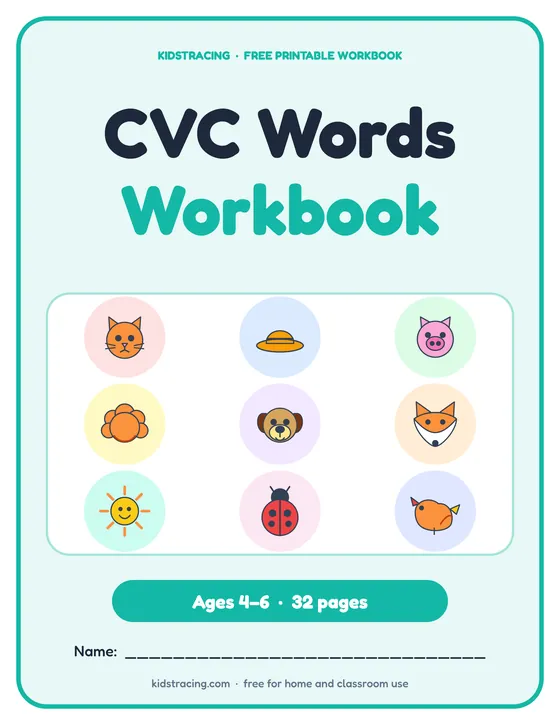
Download the CVC Words Workbook
- 32 pages for ages 4–6
- Free for home and classroom use, with no sign-up or email address
- Two PDF files: US Letter (8.5 × 11 in) and A4
- Prints in black and white or in color
Print at 100% (Actual size). Choose US Letter in the United States and Canada, and A4 almost everywhere else. How to print a workbook
Who this workbook is for
CVC words have three sounds in a consonant, vowel, consonant pattern, such as cat, pen, pig, dog and sun. They are usually the first words children can sound out and blend on their own, so they are the first step in phonics. This book is for ages 4 to 6, from children who know most letter sounds and are starting to blend, to kindergarteners who are building fluency.
It teaches one short vowel at a time, so a child never has to tell apart two similar vowel sounds in the same lesson. Make sure your child knows the letter sounds first: the ABC Tracing Book teaches letter shapes and beginning sounds, and the CVC Words List: Short A, E, I, O and U guide has longer word lists. For extra pages with your own choice of vowels, use our CVC words worksheets.
What is inside the CVC Words Workbook
The workbook has 32 pages. Every page is numbered in the bottom corner, so you can print one section at a time.
| Pages | Section | Number of pages |
|---|---|---|
| 1–3 | Cover, a page for parents and teachers, and the contents | 3 |
| 4–8 | Short a Words | 5 |
| 9–13 | Short e Words | 5 |
| 14–18 | Short i Words | 5 |
| 19–23 | Short o Words | 5 |
| 24–28 | Short u Words | 5 |
| 29–31 | Mixed Review | 3 |
| 32 | Certificate of achievement | 1 |
Short a Words (pages 4–8)
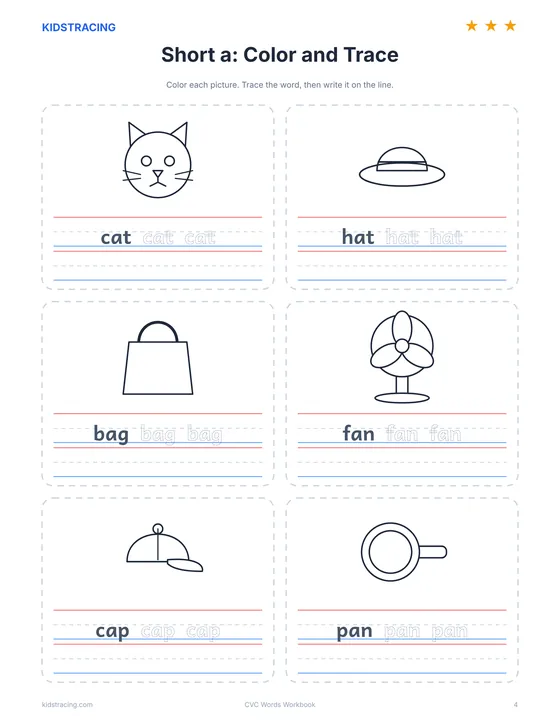
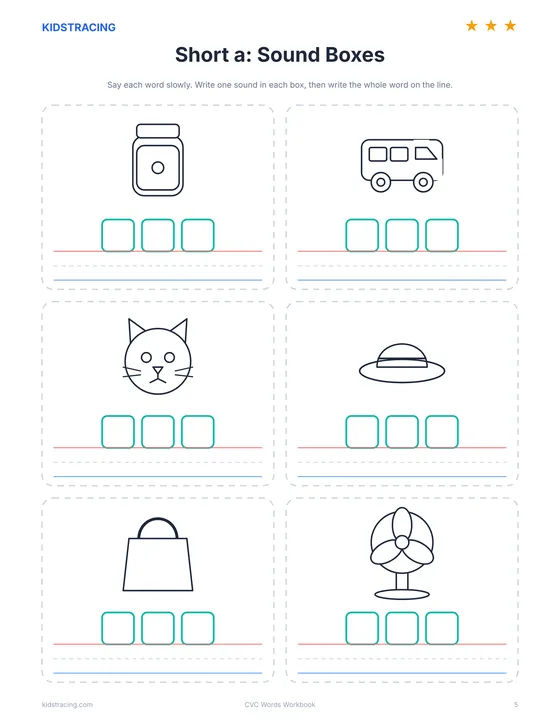
Five pages on the sound in cat. Your child colors and traces six picture words (cat, hat, bag, fan, cap, pan), builds six words in sound boxes (jam, van, cat, hat, bag, fan), traces and writes five words, traces five short sentences such as “The cat sat on a mat.”, and reads a list of 24 a-words, ticking a circle beside each one. The other vowels have lists of 15 or 16 words.
Short e Words (pages 9–13)
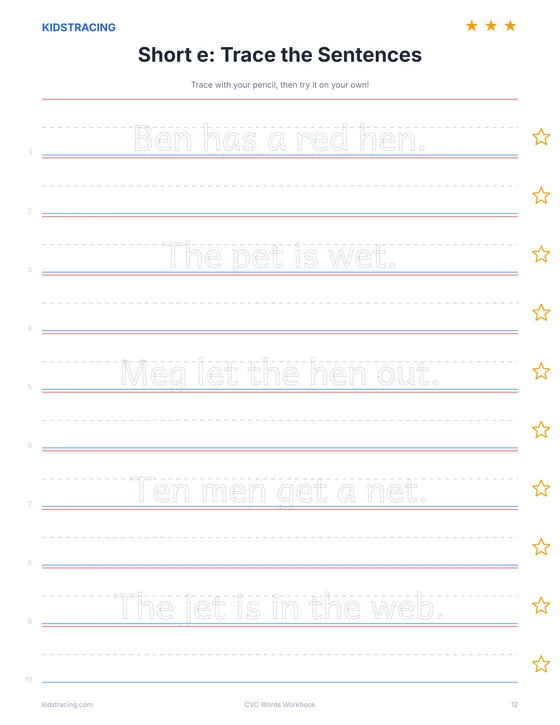
The same five-page set for the short e in bed: bed, pen, hen, net, jet and web are pictured, and the sentences use words such as red, wet, let and ten. Short e is often the hardest vowel for children to hear, because it can sound close to short i, so go slowly and say the sounds clearly.
Short i Words (pages 14–18)
Five pages on the sound in pig: pin, wig, zip, lid, pig and bib. The sentences include “The pig did a jig.” and “Tim has a big wig.” Short i and short e are often confused, so a quick review of the previous section before starting is a good idea.
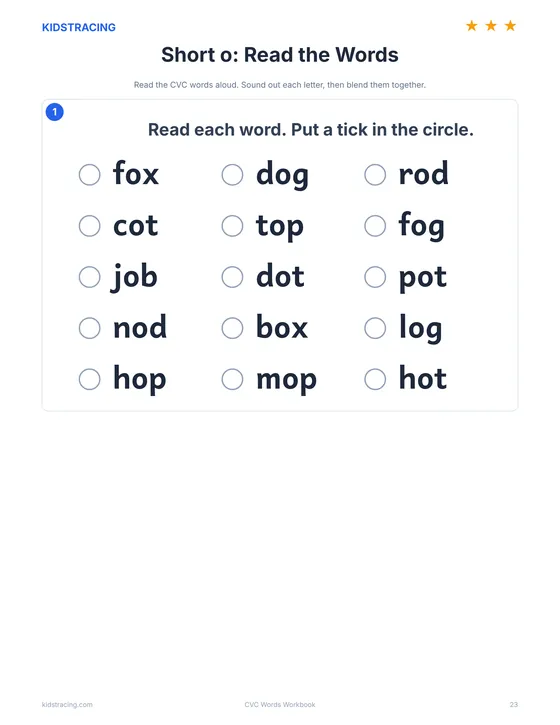
Short o Words (pages 19–23)
Five pages on the sound in fox: box, fox, pot, mop, log and top are pictured, and dog joins the sound boxes. Box and fox end in x, which makes two sounds (k and s), so these words have three letters but four sounds, which is worth pointing out when your child fills the three sound boxes.
Short u Words (pages 24–28)
Five pages on the sound in sun: sun, cup, bug, mug, rug and nut, with tub and jug added in the sound boxes. The sentences are short and silly, such as “The bug is on a rug.” and “The cub had fun.”
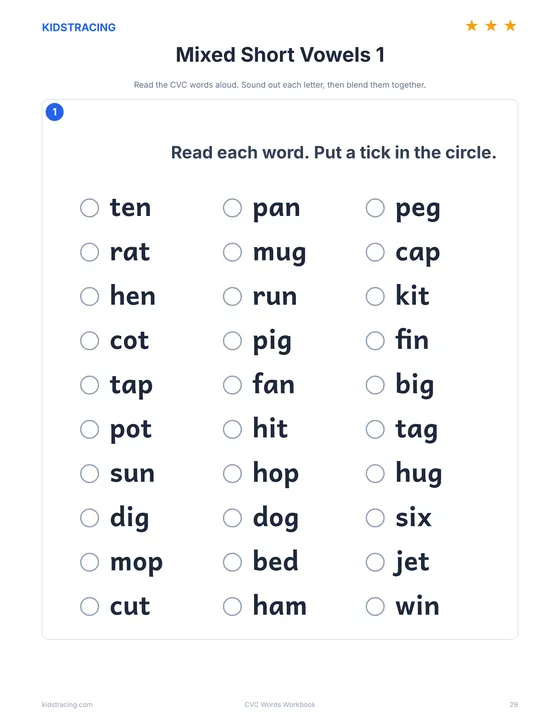
Mixed Review (pages 29–31)
Three pages to check that the five vowels are staying separate: two reading lists of 30 words each, where the short vowels are mixed, and a beginning sounds page with ten picture questions. Use them as a calm review, not as a test.
Sample pages
A few pages from the finished workbook. The PDF is sharp enough to print at full size.
Skills your child practices
- Blending three sounds into a word
- Hearing and writing the middle (vowel) sound
- Reading and spelling CVC words from a–u
- Reading short sentences
- Tracing and writing lowercase letters on lined paper
How to use this workbook
Check the letter sounds first
Choose US Letter or A4 and print at 100% (Actual size). Make sure your child knows the sounds of the letters in the section you plan to start with.
Stretch the sounds, then blend
Say “c-a-t” slowly, then faster, then as a word. Use a finger to touch each sound as you say it.
Use the sound boxes
Tap one box per sound, say the sound, then write the letter in the box. After all three boxes are filled, write the whole word on the line.
Trace the sentences
Read each sentence aloud first, then trace it. Point out the common words (the, a, is, has) that are learned by sight rather than by sounding out.
Read the word list with a pencil
Ask your child to read each word and tick the circle beside it. Re-read any words they could not read later in the week.
Words that look like CVC words but are not
A few words in the sentences are not CVC words: the, is, has and a are common “sight words” that children learn by heart, and a name or two such as Tim, Meg or Sam appear for fun. The sentence pages are meant to be read along with an adult, so help with any word that is not on the sound-it-out list.
To go beyond CVC words, children usually move to words with blends (frog, stop) and then digraphs (ship, chat). While your child is still on short vowels, the Handwriting Practice at Home: How Long and How Often guide has ideas for short, daily practice that keeps reading and writing together.
Free worksheet generators to go with this workbook
Every page in the workbook was made with the same tools you can use yourself. Use them to print extra practice with your own words, names or numbers.
CVC Words
Short a, e, i, o, u: reading, matching and word families.
Word Tracing
Trace any list of words, one word per line.
Beginning Sounds
Picture questions: which picture starts with B?
Missing Letters
Fill in the missing letters of the alphabet.
Letter Formation
A–Z strokes with numbered arrows and dotted tracing.
Guides for parents and teachers
CVC Words List: Short A, E, I, O and U
A CVC words list sorted by short vowel (a, e, i, o, u) with sentences to read, a teaching order and easy games for kindergarten and first grade.
Handwriting Practice at Home: How Long and How Often
Handwriting practice at home: how long and how often for ages 3 to 6, a 10-minute routine, setup tips and the signs that it is time to stop.
Handwriting Readiness Checklist: Is Your Child Ready to Write?
A simple handwriting readiness checklist for ages 3 to 6: ten signs your child is ready to start writing, and what to do if they are not there yet.
More free printable workbooks
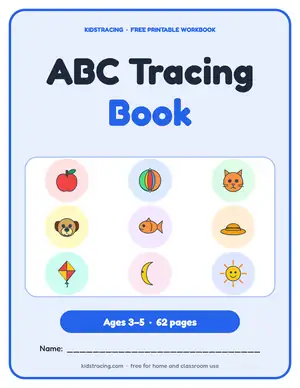
ABC Tracing Book
Every letter A to Z with numbered stroke arrows, a picture to color and a word to trace.
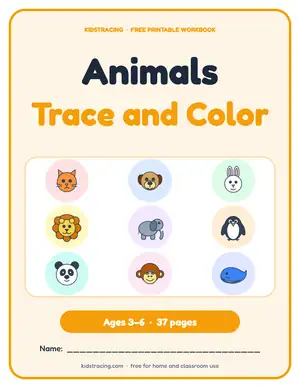
Animals Tracing and Coloring Book
Color 28 animals from the farm, the garden and the wild, trace each name and write it alone.
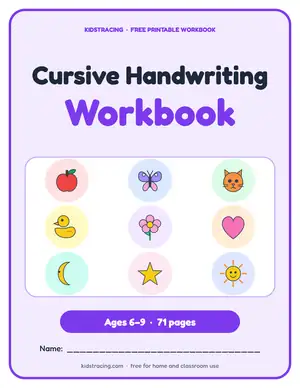
Cursive Handwriting Workbook
All 26 small and 26 capital cursive letters, then words, days, months and sentences to trace and write.
Frequently asked questions
Is the CVC Words Workbook free?
Yes. It is free for home and classroom use and needs no sign-up. Print as many copies as you need for your own children or students. Please do not sell the file or put it on another website.
What does CVC mean?
CVC stands for consonant, vowel, consonant: a three-sound word such as cat, pen, pig, dog or sun, where the middle sound is a short vowel.
Which order should we do the vowels in?
The book uses the usual order a, e, i, o, u. Some teachers start with a and o or a and i, because e and i can sound alike. Use the page numbers in the contents table to follow any order you prefer.
What are sound boxes?
Each word has three empty boxes, one for each sound. The child says the word slowly, taps one box per sound and writes a letter in each box. It is a simple way to link sounds to letters.
Can I make more practice pages?
Yes. Our CVC words worksheets make new word lists for any combination of vowels, and our word tracing worksheets make tracing pages for your own words.