Shape Worksheets for Kids
Trace, name and color the shapes children meet in letters, numbers and everyday life.
Free shape worksheet generators
Free printable workbooks
Ready-made PDF books on the same skill, to print in a planned order.
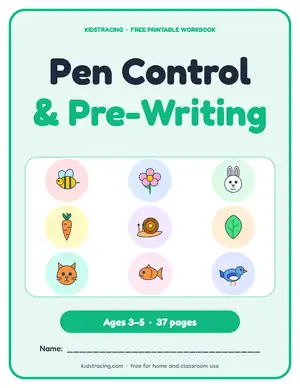
Pen Control and Pre-Writing Book
Lines, curves, zigzags, loops and spirals, plus paths from a bee to a flower, to build pencil control.
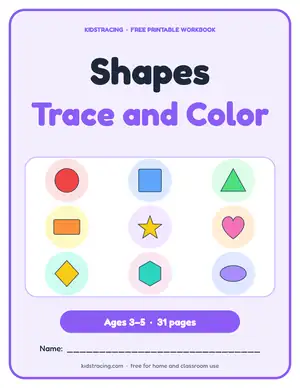
Shapes Tracing and Coloring Book
Ten shapes to trace, hunt for and color, plus tracing practice and matching games.
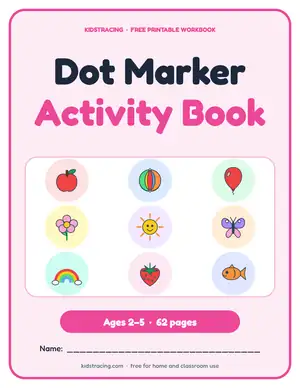
Dot Marker Activity Book
Big letters, numbers, shapes and pictures filled with circles for dot markers, stickers or fingertips.
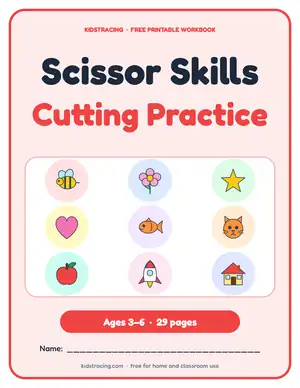
Scissor Skills Cutting Practice Book
Cutting practice from first snips to zigzags, shapes and pictures to cut out and color.
Why shapes matter
Shapes are the first drawings children copy with control, and the same strokes appear in letters and numbers. A circle becomes the o in dog and the 0 in 10, a triangle sits inside the capital A, and squares and rectangles hide inside b, d and 4. Learning to see and draw shapes is early practice for reading, writing and geometry.
From playing with shapes to drawing them
Children usually move through four stages. First they play with shapes: sorting blocks, fitting pieces into a puzzle, spotting a circle in a plate or a clock. Next they learn the names and begin to describe shapes, for example “a triangle has three sides.” Then they trace shapes, and finally they draw them from memory. Each stage supports the next, so there is no need to hurry to the pencil.
Worksheets that go with shapes
The shape tracing generator covers the tracing stage: choose any combination of eleven shapes, trace them in dotted or solid outlines and finish with a coloring strip. Other tools on this site build the same skills from different directions:
- Shadow matching and visual discrimination train children to compare shapes closely and spot differences, the visual skill behind recognizing shapes and, later, letters.
- Scissor skills includes cutting along lines and around shapes, which helps children feel how a shape is built.
- Pre-writing lines practice the straight lines, curves and loops that shapes are made from.
Next steps
After shapes, children are usually ready for pre-writing lines and then letter formation. Tracing a few shapes before each new letter is a gentle way to warm up.
Browse by age: Preschool Worksheets
Frequently asked questions
At what age can children start tracing shapes?
Many children can trace a circle and straight lines at about three years old, but there is no fixed age. If your child still grips the pencil in a fist, begin with large movements and pre-writing lines, and come back to shapes a few weeks later.
How do shape worksheets help with handwriting?
Letters and numbers are built from the same lines, curves and circles. Tracing shapes teaches the pencil control, the starting points and the direction of movement that children need for writing.
Do I need to print the shape worksheets in color?
No. The outlines are made to print well in black and white, and the coloring strip at the bottom invites your child to add the color with crayons or markers.
What should we practice after shapes?
Move on to pre-writing lines and then letter formation. Many children enjoy returning to shapes as a short warm-up before they write.