Fruits and Vegetables Tracing and Coloring Book: Free Printable (PDF)
A free 35-page workbook with fifteen fruits and eleven vegetables, one food per page. Your child colors the picture, traces the word and writes it alone on the lines, then reviews with shadow matching, picture matching and word tracing. Download the PDF in US Letter or A4 and print it at home or in class.
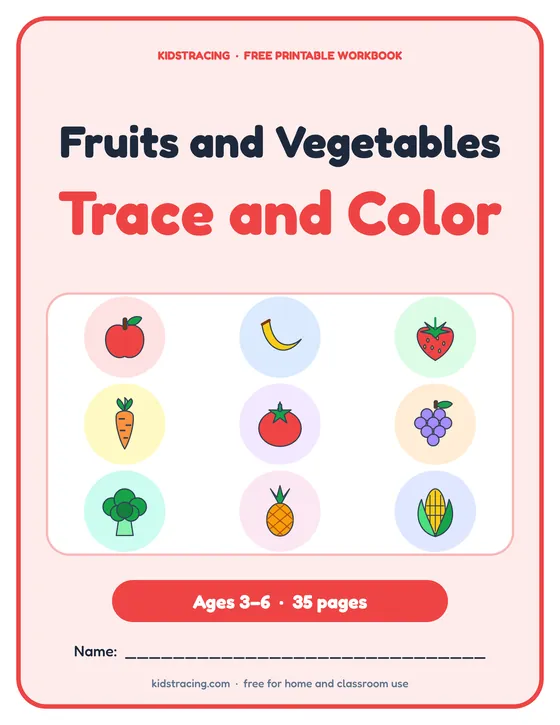
Download the Fruits and Vegetables Tracing and Coloring Book
- 35 pages for ages 3–6
- Free for home and classroom use, with no sign-up or email address
- Two PDF files: US Letter (8.5 × 11 in) and A4
- Prints in black and white or in color
Print at 100% (Actual size). Choose US Letter in the United States and Canada, and A4 almost everywhere else. How to print a workbook
Who this workbook is for
Food words are some of the first words children want to read and write, because they see and eat the real thing every day. This book is for ages 3 to 6: three- and four-year-olds can color the pictures and trace the big solid word, and five- and six-year-olds can finish the practice lines and the word games on their own.
Every page follows the same simple pattern, so children quickly know what to do without help. If you want a page for a food that is not in the book, our word tracing worksheets turn any list of words into a tracing sheet. For more picture-based fun, the Animals Tracing and Coloring Book works the same way.
What is inside the Fruits and Vegetables Tracing and Coloring Book
The workbook has 35 pages. Every page is numbered in the bottom corner, so you can print one section at a time.
| Pages | Section | Number of pages |
|---|---|---|
| 1–3 | Cover, a page for parents and teachers, and the contents | 3 |
| 4–18 | Fruits | 15 |
| 19–29 | Vegetables | 11 |
| 30–34 | Food Word Games | 5 |
| 35 | Certificate of achievement | 1 |
Fruits (pages 4–18)
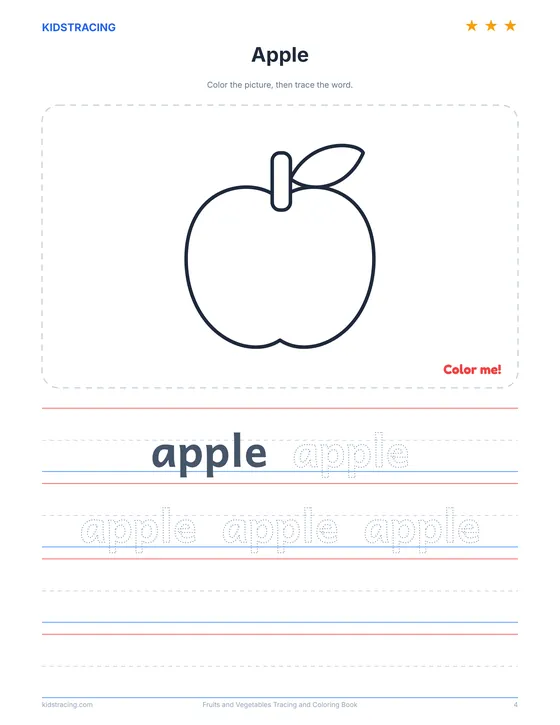
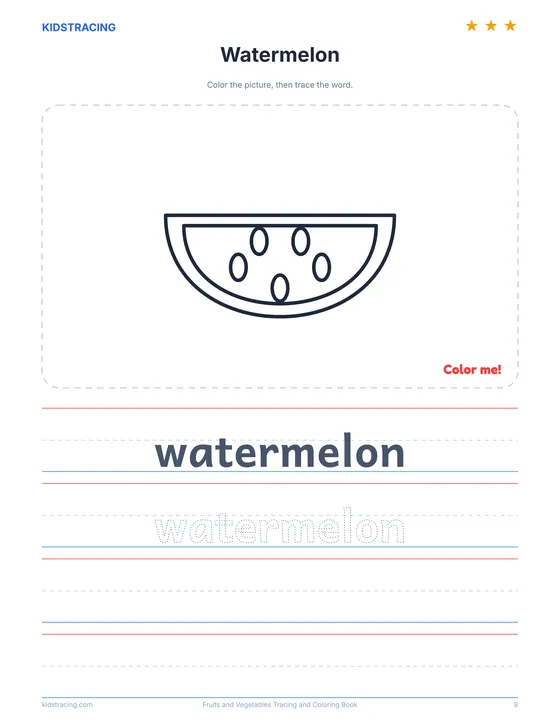
Fifteen fruits, one per page: apple, banana, orange, grapes, strawberry, watermelon, pear, lemon, cherries, peach, pineapple, avocado, kiwi, plum and mango. A large outline picture fills the top half of the page for coloring. Below it is the word in solid letters beside a dotted copy, then three more dotted copies to trace and two empty lines for writing the word from memory. Short words such as pear and plum come first, and watermelon and strawberry (ten letters each) are a fun challenge for confident writers.
Vegetables (pages 19–29)
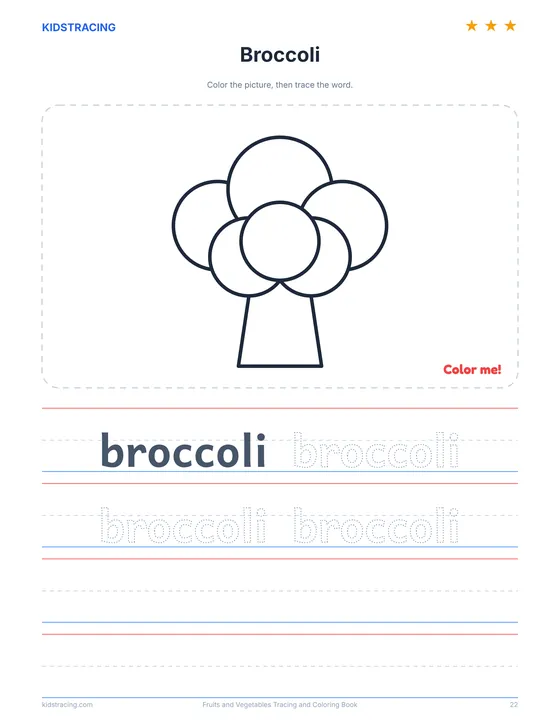
Eleven vegetables with the same page layout: carrot, tomato, corn, broccoli, pumpkin, potato, mushroom, eggplant, pepper, onion and cucumber. The set is sorted the way a kitchen sorts food, so a few items are not strictly vegetables to a botanist (see the note below). Corn is the shortest word and eggplant and mushroom are the longest, so you can pick the pages that match your child’s stamina.
Food Word Games (pages 30–34)
Five review pages. Two shadow matching pages ask your child to draw a line from each fruit to its dark shadow, and a picture matching page pairs identical fruits. The last two pages are word-tracing sheets with five words each, one for fruit (apple, banana, grapes, lemon, orange) and one for vegetables (carrot, tomato, corn, potato, onion), traced in light gray with space to write them again.
Sample pages
A few pages from the finished workbook. The PDF is sharp enough to print at full size.
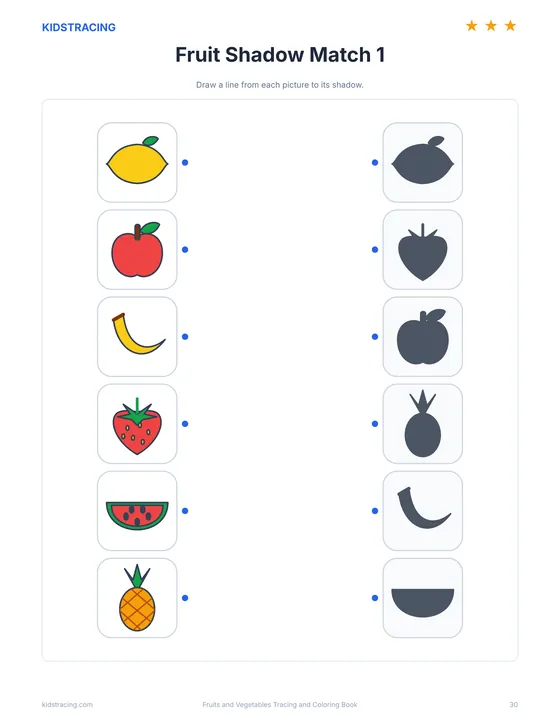
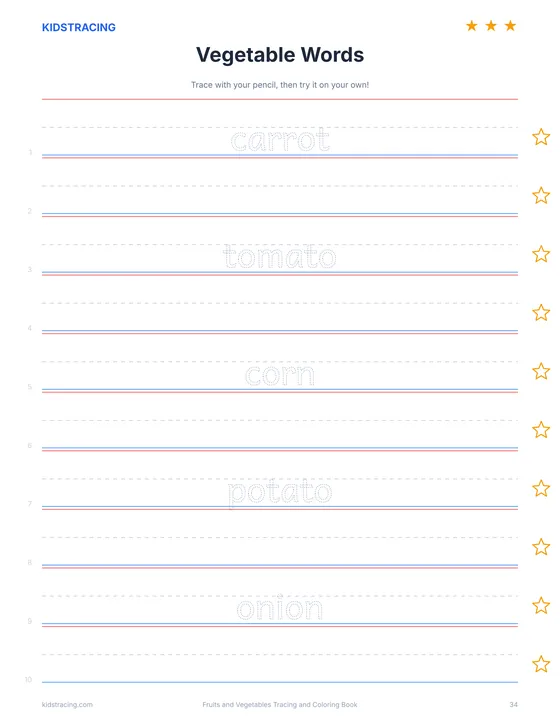
Skills your child practices
- Naming and spelling common foods
- Tracing and writing lowercase words on lined paper
- Coloring inside outlines for hand control
- Matching a picture to its shadow or its twin
- Building a food vocabulary for talking and reading
How to use this workbook
Print and pick a few foods
Choose US Letter or A4 and print at 100% (Actual size). Start with foods your child already knows and likes. Type a page range such as 4-9 to print only those pages.
Say the word and clap its beats
Clap the syllables before writing: ba-na-na has three claps and wa-ter-mel-on has four. It makes longer words feel less scary.
Color first
Let your child pick the colors. A purple carrot is fine, and so is a blue banana. Coloring is a warm-up for the pencil work to come.
Trace the word, then write it alone
Follow the solid word and dotted copies with a pencil, starting from the left. The two empty lines are for writing the word from memory.
Link it to real food
Look for the same food in the kitchen or at the market. Ask “is it a fruit or a vegetable?” and “where does it grow?” to turn a worksheet into a conversation.
Fruit or vegetable?
Botanists call a food a fruit if it grows from the flower of a plant and holds seeds. By that rule tomatoes, peppers, cucumbers, eggplants, pumpkins and avocados are all fruits. Cooks, shops and most children call them vegetables, so the book groups them by how we eat them. If your child asks, this is a nice small science fact to share. A mushroom is neither: it is a fungus.
The long words in this book are a good place to practice breaking words into parts. The guide on How to Teach Syllables to Preschool and Kindergarten Children shows simple clapping and tapping games, and the Shadow Matching Activities for Preschoolers guide explains why matching pictures to shadows builds the careful looking that reading needs.
Free worksheet generators to go with this workbook
Every page in the workbook was made with the same tools you can use yourself. Use them to print extra practice with your own words, names or numbers.
Word Tracing
Trace any list of words, one word per line.
Shadow Matching
Join each picture to its shadow: 4 to 10 pairs.
Picture Matching
Match identical pictures or things that go together.
Beginning Sounds
Picture questions: which picture starts with B?
Syllable Counting
Clap and count 1 to 4 syllables with pictures.
Guides for parents and teachers
How to Teach Syllables to Preschool and Kindergarten Children
How to teach syllables to young children: the clap and chin methods, a 4-step plan from names to long words, word lists for 1 to 4 syllables and games.
Shadow Matching Activities for Preschoolers
What shadow matching is, the skills it builds and eight easy shadow matching activities for preschoolers, from printable sheets to flashlight play.
Handwriting Practice at Home: How Long and How Often
Handwriting practice at home: how long and how often for ages 3 to 6, a 10-minute routine, setup tips and the signs that it is time to stop.
More free printable workbooks
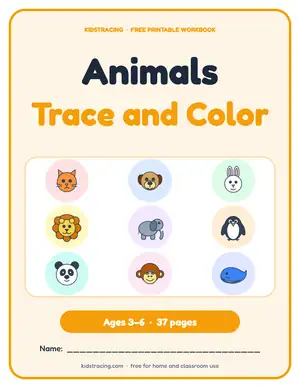
Animals Tracing and Coloring Book
Color 28 animals from the farm, the garden and the wild, trace each name and write it alone.
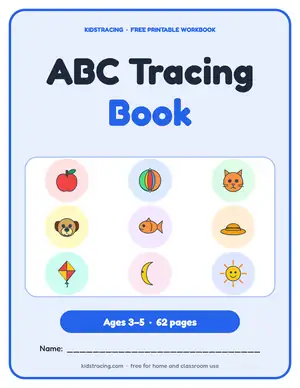
ABC Tracing Book
Every letter A to Z with numbered stroke arrows, a picture to color and a word to trace.
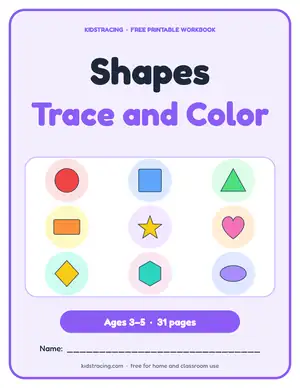
Shapes Tracing and Coloring Book
Ten shapes to trace, hunt for and color, plus tracing practice and matching games.
Frequently asked questions
Is the Fruits and Vegetables book free?
Yes. Download it, print as many copies as you need for your own children or students and use it at home or in class. Please do not sell the file or put it on another website. No sign-up or email address is needed.
Which fruits and vegetables are in the book?
Fifteen fruits (apple, banana, orange, grapes, strawberry, watermelon, pear, lemon, cherries, peach, pineapple, avocado, kiwi, plum, mango) and eleven vegetables (carrot, tomato, corn, broccoli, pumpkin, potato, mushroom, eggplant, pepper, onion, cucumber).
Do the pictures need to be colored in a certain way?
No. The pictures are black outlines on purpose, so children can choose any colors. For a bonus game, ask them to color the food the way it looks in real life and then to make a silly version.
Can I add other foods?
Yes. Type any food words into our word tracing worksheets and print a page of your own, for example for bread, cheese, rice or eggs.
Is there a test or answer key?
No. Every page is practice, and the matching pages are self-checking: your child can see whether a line joins a picture to its twin or its shadow.